
For supply chain leaders, the promise of AI has never been louder… or more misleading. AI is routinely positioned as a fast path to efficiency, often claiming 20 to 30% reductions in workload. Yet many organizations are experiencing the opposite, with an increase in effort, at least in the early stages. Teams find themselves spending more time validating outputs, troubleshooting unexpected recommendations, and trying to understand how the system arrived at its conclusions. In fact, research from MIT has highlighted the scale of the challenge, with research suggesting that up to 95% of AI projects fail to deliver on their original promises.
This disconnect between expectation and reality is not anecdotal. The issue isn’t that AI lacks potential, but that implementation is often approached incorrectly.
For supply chain planning, success depends on how well the organization aligns objectives, manages change, and embeds context into the system.
The Expectation Gap: Why AI Feels Harder Before It Gets Easier
AI implementation mirrors a familiar pattern in supply chain transformation. Consider inventory optimization projects: organizations often expect immediate reductions in inventory, yet the short-term effect is typically the opposite. Inventory rises first as gaps are filled, and only over time do efficiencies materialize.
AI follows a similar trajectory. Early phases require investment in training models, refining data inputs, and validating outputs. This creates additional workload upfront. The mistake many organizations make is interpreting this temporary friction as failure rather than as a natural phase of maturity.
Organizations that succeed with AI recognize that early effort is not wasted; it is foundational. This is where experienced partners like John Galt Solutions play a critical role, helping companies set realistic expectations and structure deployments in a way that delivers sustainable value rather than short-term optics.
These are three main reasons why AI projects in supply chain fail to deliver, and what you can do to succeed.
Reason #1: Misaligned Objectives and Misapplied Technology
One of the most common reasons AI initiatives fail is surprisingly simple: organizations are not clear on the problem they are trying to solve. One of the crucial initial steps for implementing AI is to articulate a clear vision, with clear goals and objectives. Without this, teams experiment with AI in ways that generate activity but not value.
Some key questions to start are: What specific business problem are we solving? Is the goal to improve forecast accuracy? Optimize inventory levels? Increase service levels? Reduce transportation costs?
Different AI approaches are suited to different challenges. For example, generative AI excels at synthesizing and communicating information, but it is not inherently designed for demand forecasting or inventory optimization. Applying the wrong type of AI to the wrong problem leads to poor outcomes and erodes trust in the technology.
The key is prioritization. High-impact use cases aligned with broader business goals such as cost reduction, resilience, or customer service, should come first. This ensures that AI investments are tied directly to measurable outcomes.
John Galt Solutions supports organizations in this critical phase by helping map the right AI capabilities to the right supply chain challenges, ensuring that deployments are both feasible and impactful.
Reason #2: Underestimating Change Management
Even the most advanced AI solution will fail if people do not adopt it. This is where many implementations fall short: they treat AI as a technology deployment rather than an organizational transformation.
Effective AI adoption requires structured change management layered alongside implementation. This includes five essential components:
- Awareness of the need for change
- Desire to support the change
- Knowledge of how to change
- Ability to implement new ways of working
- Reinforcement to sustain the change
The human response to change follows a predictable curve. Teams often begin with optimism and can quickly shift to skepticism before they move toward hope and confidence (hopeful realism). Organizations that abandon AI initiatives during this “informed pessimism” phase rarely realize the long-term benefits.
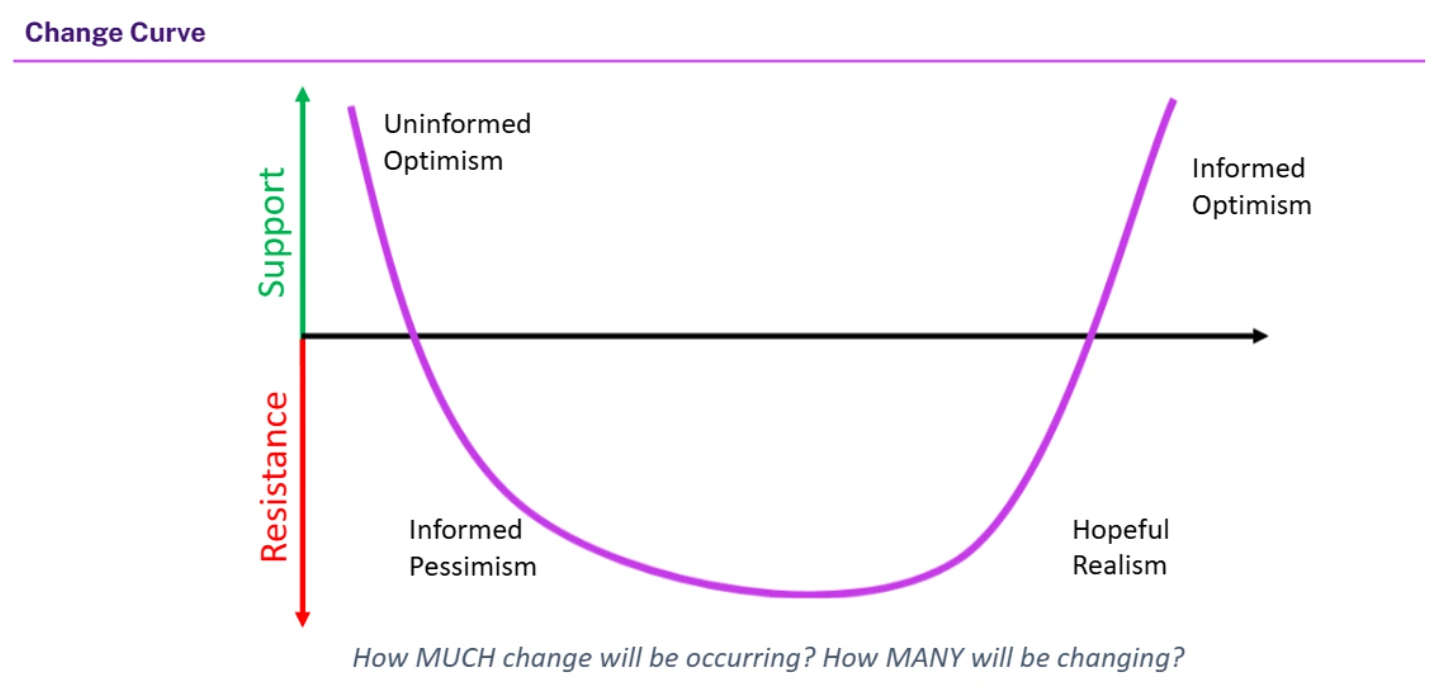
Leaders must actively guide teams through this curve. That means clearly communicating the purpose of AI, addressing fears about job displacement, and demonstrating how the technology enhances (which is far from replacing) human decision-making.
It also requires practical reinforcement: celebrating early wins, encouraging experimentation, and providing tools to overcome obstacles. Change does not happen passively: it must be managed intentionally.
John Galt Solutions incorporates change management into every phase of AI deployment, helping organizations build internal alignment, accelerate adoption, and build the foundation required to sustain long-term success.
Reason #3: Lack of Context
AI is only as effective as the context it operates within. In supply chain planning, this is particularly critical. Algorithms can process vast amounts of data, but without an understanding of business nuances, such as customer priorities, regional dynamics, or operational constraints, their outputs can miss the mark.
AI initiatives often struggle because they lack the contextual intelligence needed to generate meaningful recommendations.
Context transforms AI from a reactive tool into a proactive decision engine. It enables systems to:
- Identify patterns and relationships across the supply chain
- Diagnose root causes of disruptions
- Tailor insights to specific roles and users
- Anticipate risks before they materialize
- And so much more
The emergence of agentic AI further amplifies the importance of context. These systems can collaborate, share information, and adapt recommendations based on evolving conditions across the network. For example, an issue in a regional distribution center can be evaluated in terms of its global impact, with tailored recommendations provided to planners.
However, context depends on data, and data quality remains a concern for many organizations. While high-quality data is important, waiting for perfect data can stall progress indefinitely. Instead, organizations should focus on continuous improvement: cleansing, connecting, and contextualizing data over time.
Modern supply chain planning software like the Atlas Planning Platform supports this process through data quality scoring, automated harmonization, and hierarchical modeling. In many cases, AI itself can enhance data quality by identifying inconsistencies and enriching datasets.
John Galt Solutions helps organizations bridge this gap by combining advanced AI capabilities with deep supply chain expertise, ensuring that systems are trained not just on data, but on the realities of how businesses operate.
Turning AI Potential into Real Supply Chain Value
AI in supply chain planning is a journey that requires a vision with clear objectives and a realistic commitment to change. Organizations that succeed understand three fundamental truths:
- AI will require effort before it delivers
- Technology must be aligned to the right problems
- Context, both human and data-driven, is essential to making AI work.
By addressing these factors head-on, supply chain leaders can move beyond the hype and unlock meaningful, lasting value from AI.
This is where John Galt Solutions continues to differentiate itself. More than a technology provider, the John Galt team is your partner in transformation. By aligning AI capabilities with real business challenges, embedding change management into every deployment, and ensuring that context drives every recommendation, we help teams turn AI into a driver of smarter, more resilient supply chain planning. Let’s make it happen.


