
TL;DR:
Supply chain organizations can build a competitive advantage by connecting internal and external data, and applying AI to turn signals into actionable insights. Best part, you don’t need perfect data to start. Advanced supply chain planning solutions like the AI-powered Atlas Planning Platform help companies mature their data strategy and shift from reactive to proactive planning.
The Role of Data in Modern Supply Chain Planning
Supply chain planning today is defined by volatility, complexity, and constant pressure to deliver faster, smarter, and more cost-effective outcomes. Global disruptions, shifting consumer behavior, omnichannel demand, and geopolitical uncertainty are pushing supply chain teams to transform how they plan and operate. At the center of this transformation sits data.
Data is the strategic fuel that powers modern supply chain planning. Yet despite its importance, many organizations remain stuck; overwhelmed by the volume of data, paralyzed by perceived data quality issues, or overly reliant on ERP systems alone. It’s time to change that.
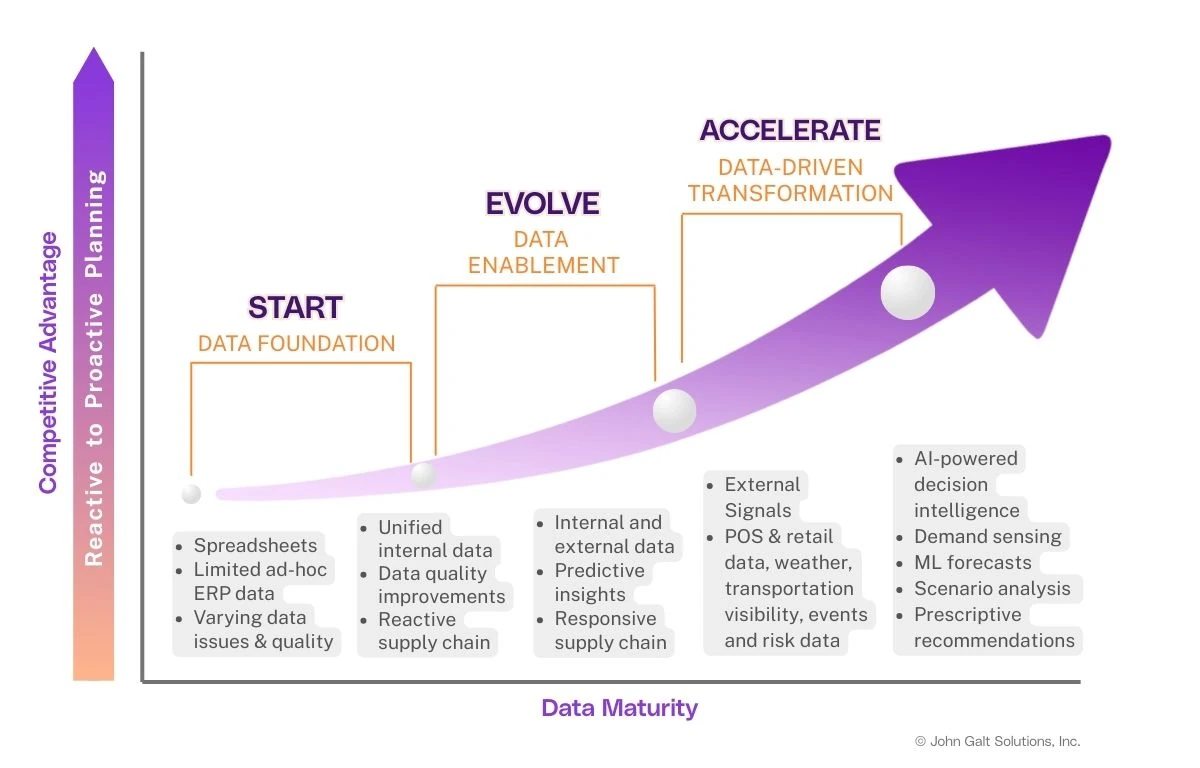
This playbook follows John Galt Solutions’ Pathways to Evolve methodology, designed to help you move forward with a practical, step-by-step approach to mature your supply chain planning processes. It guides you through a clear Start, Evolve, Accelerate journey, meeting you where you are today and growing with you as your planning competence advances.
Learn how to start your data strategy journey, unlock value from both internal and external data, and make data actionable at scale using modern supply chain planning software like the Atlas Planning Platform.
“High-performing companies are 2 - 3 times more likely to utilize external data to provide greater context when making decisions.”
Gartner Research: Use Assumptions to Drive Effective Supply Chain Planning Decisions. Published: 13 November 2024. G00790259
START Your Data Strategy Journey
Move Beyond ERP
One of the most persistent myths in supply chain transformation is the belief that data must be perfect before it can be useful. In reality, supply chains already make critical decisions every day using available data – perfect or not. Waiting for flawless inputs only delays progress.
During a recent webinar, Jennifer Stark, Director of Planning at 1440 Foods, shared insights on how her team was able to work with the Atlas Planning Platform leveraging the data they had available to navigate change, and improve over time as they set the stage for scalable growth.
“We’ve really learned that you don’t need perfect data to start. We were able to revise and update data as we went. We started with some strong assumptions around shelf life or around lead times and MOQs (minimum order quantity) and used that to just plug into the system to start seeing how it works, knowing that we could go back and revise later.” - Jennifer Stark, Director of Planning at 1440 Foods
A modern data strategy begins by moving beyond a narrow focus on ERP systems. While ERP remains foundational, it represents only a fraction of the data universe influencing supply chain performance. Valuable signals exist across execution systems, commercial platforms, and external sources, all of which can incrementally improve planning accuracy.
An iterative approach allows organizations to:
- Start with the data available, even if it’s incomplete
- Use historical patterns and proxy attributes where gaps exist
- Refine assumptions over time as new data sources are connected
- Continuously improve both decisions and data quality through use.
Imperfect Data Is Still Valuable Data
Imperfect internal data should not be treated as a blocker. Instead, it should be seen as an opportunity. Each planning cycle improves understanding, highlights gaps, and feeds learning back into the system. Over time, this creates a self-correcting, more resilient supply chain.
EVOLVE: Unify Internal and External Data
Internal Data: The Hidden Goldmine Within Your Organization
Internal data is often misunderstood as “whatever lives in the ERP.” In reality, ERP is only the tip of the iceberg. Across most organizations, valuable internal signals are scattered across multiple systems, each offering unique insights into demand, supply, and execution.
Example Key Sources of Internal Supply Chain Data
- Manufacturing Execution Systems (MES): Granular production performance, run rates, yields, and constraints that ERPs often lack.
- Product Lifecycle Management (PLM): Product attributes, launch timing, specifications, and innovation pipelines critical for new product forecasting.
- Customer Relationship Management (CRM): Pipeline demand, promotions, customer behavior, and sales activity.
- Order Management Systems (OMS): Order patterns, fulfillment performance, and channel dynamics.
- Transportation & Warehouse Management Systems (TMS/WMS): Logistics constraints, capacity, lead times, and execution variability.
- Ecommerce Platforms & Digital Channels: Search trends, conversion rates, browsing behavior, social media and digital demand signals.
External Data: Planning From the Outside In
Relying solely on internal data is no longer enough. External data provides the real-world context needed to sense demand shifts early, anticipate disruptions, and respond proactively rather than reactively.
High Impact Categories of External Data
- Transportation Visibility: Realtime shipment tracking and in-transit delays
- Weather & Environmental Data: Forecast-driven impacts on demand, production, and logistics
- Point of Sale (POS) & Consumer Demand Intelligence: Store-level sales, inventory, and shelf insights
- Market & Economic Indicators: Inflation, employment, commodity pricing, and macroeconomic trends
- Risk & Resilience Data: Supplier risk, geopolitical events, natural disasters, and capacity disruptions.
4 Key Steps to Leverage Your Supply Chain Data
- Prioritize What Matters Most - Focus on data sources that directly impact your planning decisions (e.g. demand volatility, service levels, or risk exposure).
- Ensure Context and Relevance - Data must be timely, cleansed, and harmonized. The value lies not in volume, but in actionable insight.
- Choose a Platform Built for Integration - External data is only powerful when it flows seamlessly into planning workflows, scenario models, and collaboration processes.
- Understand the Spectrum of Sources - External data may come from paid services, partners, customers, suppliers, government sources, or even your own digital exhaust beyond ERP.
ACCELERATE with AI
The Role of AI in Your Supply Chain Data Strategy
As data becomes more unified and enriched, artificial intelligence (AI) can be layered on top of your capabilities to significantly accelerate planning effectiveness. AI acts as a force multiplier that turns connected data into scalable, repeatable decisions.
With data volumes growing and driving supply chain complexity, AI is foundational to turning data into decisions at scale. AI allows teams to connect fragmented data sources and actionable planning insights, enabling organizations to move faster, plan smarter, and continuously improve.
From Data Collection to Decision Intelligence
Traditional planning approaches rely heavily on static rules, manual analysis, and backward-looking averages. AI fundamentally changes this paradigm, helping you:
- Detect Patterns Humans Can’t See: Machine learning models identify non-linear relationships across large internal and external datasets, revealing demand drivers, seasonality shifts, and emerging risks earlier.
- Improve Signal-to-Noise Ratio: AI helps filter out irrelevant or misleading data, ensuring planners focus on what truly matters rather than being overwhelmed by volume.
- Learn Over Time: Unlike static models, AI continuously learns as new data becomes available, improving forecast accuracy and recommendation quality with each planning cycle.
AI as a Catalyst for Data Quality and Trust
One of the most powerful (and often misunderstood) aspects of AI is its ability to work with imperfect data. While clean data improves outcomes, AI models can fill gaps using proxy attributes and historical analogs. It can also weigh data sources based on reliability and relevance, and adjust as better-quality data becomes available.
AI helps improve data quality through automated monitoring, anomaly detection, and governance tools. AI-driven platforms like Atlas Planning surface inconsistencies early, helping build trust across the organization. Over time, this creates a virtuous cycle where better decisions lead to better data, and better data fuels better decisions.
The Atlas Planning Platform helps companies make use of AI to transform data from a static asset into a dynamic, learning system that empowers supply chains to anticipate change and adapt with confidence.
AI-powered planning enables organizations to move beyond reactive decision-making through:
- Demand Sensing: Incorporating near-real-time signals such as POS data, weather, events, and transportation updates
- What-If Scenario Modeling: Rapidly simulating the impact of demand spikes, supply disruptions, or logistics constraints
- Prescriptive Recommendations: Providing planners with actionable insights and options to optimize service, cost, and risk trade-offs.
- AI Look Back Analysis: AI aids in utilizing and reviewing historical data, making connections from seemingly disparate data and identifying the impact across the supply chain to drive improvements.
The Atlas Planning Platform and Our Partner Ecosystem
The Atlas Planning Platform from John Galt Solutions is purpose-built to turn diverse data into actionable intelligence. Atlas simplifies data ingestion, harmonization, and application across the entire planning environment, turning diverse data into actionable intelligence.
Strategic Data Partnerships
Atlas connects seamlessly with leading solutions to deliver outside-in signals directly into planning workflows, enabling proactive decision-making. These partnerships include:
- GE Vernova Proficy Smart Factory MES: Seamless integration of MES data
- FourKites: Realtime transportation and shipment visibility
- Resilinc: Supply chain risk and disruption monitoring
- SPS Commerce: Store-level POS, inventory, and shelf data across 1,000+ retailers-level POS, inventory, and shelf data across 1,000+ retailers level POS, inventory, and shelf data across 1,000+ retailerslevel POS, inventory, and shareofshelf data across 1,000+ retailerslevel POS, inventory, and shareofshelf data across 1,000+ retailers
- Treefera: Real-time insights on commodities, carbon, risk and compliance across the supply chain
- Shipwell: unified transportation management and real-time visibility.
Benefits of a Modern Data-Driven Strategy Across the Supply Chain
Organizations that embrace a pragmatic, integrated, and AI-enabled data strategy can expect measurable, cross-functional benefits, while creating a supply chain network that is fundamentally more adaptive in the face of uncertainty.
| Capability Area | Traditional Approach | Data + AI-Driven Outcome |
| Demand Forecasting | Lagging, shipment-based forecasts | Demand sensing using POS, events, and external signals |
| Inventory Management | High buffers and frequent firefighting | Leaner inventory, fewer stockouts and overstocks |
| Planning Speed | Manual analysis and long cycle times | Faster scenario modeling and decision support |
| Cross-Functional Alignment | Siloed views across teams | Single source of truth for sales, finance, and operations |
| Risk Management | Reactive response to disruptions | Early warning signals and proactive mitigation |
| Decision Quality | Judgment-based and static rules | AI-supported, continuously improving recommendations |
Strategic Outcomes
- Improved Forecast Accuracy: Better demand sensing through real-time and external signals
- Reduced Inventory Costs: Lower carrying costs without sacrificing service levels
- Faster Response Times: Proactive planning driven by early insights and scenarios
- Stronger Organizational Alignment: Shared, trusted data across functions
- Greater Resilience: Enhanced visibility into disruptions, risks, and recovery paths
How Data Maturity Drives Your Supply Chain Planning Competitive Advantage
Final Thoughts: Progress Over Perfection
The competitive advantage belongs to those who use their data best. You don’t need perfect data to begin, but you need the willingness to start, the discipline to iterate, and the right technology to connect insight with action.
By unlocking internal data, integrating external signals, and leveraging platforms like Atlas, your supply chain can transform complexity into clarity, and turn uncertainty into opportunity. Start your data journey now with John Galt Solutions and the Atlas Planning Platform.
Frequently Asked Questions (FAQs)
- 1. Do we need perfect data before investing in advanced supply chain planning or AI?
No. Most organizations are already planning with imperfect data today. Modern supply chain planning platforms and AI models are designed to work with organizations’ incomplete, inconsistent, and evolving datasets. The key is to start with the data you have, incrementally improve decisions, and allow better planning outcomes to feed continuous data quality improvements over time.
- 2. Is ERP data not enough for supply chain planning?
ERP data is necessary, but it’s usually not sufficient because critical supply chain signals live outside ERP systems, including MES, PLM, CRM, TMS, WMS, e-commerce platforms, and retail POS data. Relying solely on ERP limits visibility and keeps planning reactive. Companies can truly unluck value when these sources are unified into a single planning environment.
- 3. How does external data improve planning outcomes?
External data provides context that complements internal data. For example, retail sell-through data improves demand sensing, weather and event data anticipate demand spikes, transportation visibility highlights execution risk, and market indicators inform more strategic decisions. When combined seamlessly and directly into supply chain planning workflows with a platform such as Atlas, these signals enable faster, more proactive responses.
- 4. What role does AI play compared to traditional analytics?
Unlike traditional analytics that explain what happened, AI does further by helping teams predict what will happen next, and it also provides recommendations on what to do about it. AI models detect complex patterns across large datasets, continuously learn as conditions change, and support rapid scenario modeling, allowing planners to evaluate trade-offs and act with confidence.
- 5. How long does it take to see value from a modern data-driven planning approach?
Organizations that start leveraging and expanding their use of data often see early benefits such as improved forecast accuracy, better visibility, and faster planning cycles, within the first few planning iterations. Because the approach is iterative, value compounds over time as more data sources are connected and AI models learn from each cycle.
- 6. Who should own the supply chain data and AI strategy?
Instead of someone specific owning the data and AI strategy in the supply chain, the key is for companies to treat these as cross-functional assets. While supply chain teams typically lead planning initiatives, collaboration with IT, finance, sales, and commercial teams is essential to ensure alignment, governance, and shared ownership of outcomes.


