
Responding Faster with Greater Confidence to Business Disruptions
The Food & Beverage industry has a track record of remarkably stable growth of approximately four percent across consumer and food service sectors combined. Big swings have historically come from promotional demand and wildly successful new product launches which are no comparison to the variability that has rocked the industry since March 2020.
COVID-19 forced farmers to dump milk and leave crops to rot in fields while meat processing operations were shuttered or sparsely staffed, leaving farmers without a place to process cows, pigs, and chickens. Consumers began stockpiling food, which led to huge demand surges and stock-outs at grocery stores and other retail outlets. Meanwhile, schools, restaurants, retail, and office buildings closed with only a few days’ notice, slashing total food service demand by 50% or more.
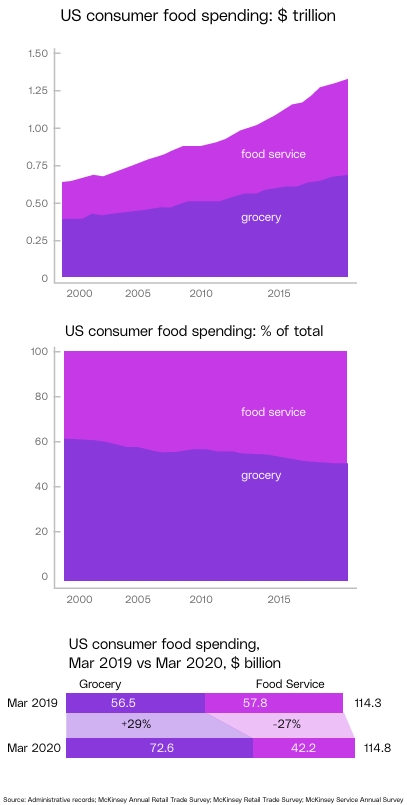
A report from McKinsey & Company, US Food Supply Chain: Disruptions and Implications from COVID-19, highlights the dramatic changes in consumer behavior and the ripple effect through US food and agricultural supply chains. Exhibit 1 highlights the US consumer food spending mix between Food Service and Grocery channels and the dramatic swing increasing Grocery by 29% and decreasing Food Service by 27% in year-over-year US consumer food spending comparisons of March 2019 and 2020.
Until March 2020, consumer food spending had converged on equilibrium between grocery and food service.
While many F&B companies have struggled to respond to the rapid changes in consumer behavior, forward-thinking F&B companies that invested in advanced supply chain planning systems before the initial pandemic impact responded with greater resiliency.
Digital supply chain technology helped forward-thinking F&B companies gain insights faster, perform simulations and what-if scenario analysis, and collaborate with suppliers upstream and customers downstream to pivot operations and transition from food service to grocery and consumer packaging.
The COVID-19 pandemic showed how quickly the F&B landscape can shift. And, the leverage advanced digital supply chain platforms can bring to evaluating real-time data across the supply chain to help F&B companies turn challenges into opportunities including the ability to gain market share and grow profits, despite a multitude of COVID-19 obstacles.
FIVE Steps to Gain Supply Chain Resiliency
Today’s supply chains are under constant pressure as new risks emerge. We have identified five key steps to help you gain an edge and drive resilience throughout your network.
Step 1: Assess Demand to Accelerate Response
Historically, consumer demand has been stable and experienced a small, but consistent growth rate of four percent for the combined grocery and food service sectors. Today’s consumers demand safe, fresh, and healthy foods delivered across multiple channels, packaging and taste profiles. This has led to a proliferation of product SKUs. It has also evolved into supplier relationships that make smaller and more frequent deliveries and shorter production cycles all adding complexity to supply chain planning.
With significant disruptions such as COVID-19, food & beverage businesses experienced two opposing shifts in demand patterns – the 27 percent collapse of the food service sector and the dramatic 29 percent spike for demand through grocery and other retail channels. This caused significant challenges to move product from the commercial food service channel to the consumer-focused retail channels. Food service suppliers faced abrupt order cancellations leaving them with excess stock that could not easily move to consumers due to packaging sizes, labeling and pricing options.
Supply chain planners need the ability to quickly evaluate demand for products across a variety of product, channel and shelf life profiles.
- Increase forecast accuracy by leveraging multiple demand signals including historic demand, seasonality, point of sale and online buying trends. Leverage these signals for greater influence and continuous planning based on time to market.
- Leverage analytics to optimize product portfolios and focus on top sellers in time of constrained supply and tight distribution networks.
- Evaluate demand for all channels and movement from food service to grocery to synchronize raw materials, packaging and production schedules.
Step 2: Reduce Waste and Increase Sustainability
Consumers want fresher products and more information about the harvesting and manufacturing of the products and brands they consume. Not only do they seek fresh food alternatives, they crave food produced and packaged in environmentally friendly ways. While many F&B manufacturing plants tend to be very capital intensive and prefer longer and more efficient production runs, today’s sustainability initiatives and shorter production runs enable better synchronization with market demand to deliver longer shelf life with fresher products for consumers.
- Leverage machine learning to evaluate multiple scenarios and optimize production schedules for quicker distribution of fresher products.
- Drive production efficiencies by focusing on top sellers to maximize resources during times of constrained operations including labor availability.
- Support circular economy strategies with greater visibility across the end-to-end supply chain.
Step 3: Boost End-to-End Supply Chain Visibility
Food and beverage supply chains are unique. Supplies are often seasonal and only available from certain regions of the globe during set times of the year. Food products have limited shelf life, rely on marketing promotions, and timely distribution is essential to sustain competitiveness. In this climate, companies must control production, distribution, and coordinate supply and demand.
Get ahead of the competition with end-to-end supply chain visibility and synchronization. A resilient F&B supply chain can mitigate disruption, reduce risk once disruption occurs, and recover quickly. With advanced analytics, companies can gain insights into the business, visualize market events in real time and create “what-if” scenarios to assess trade-offs across the supply chain and obtain data-driven decisions.
- Augment the ability to work with multiple sources and suppliers to increase your agility.
- Identify and understand the impact of promotional demand and customer priorities.
- Leverage POS, weather, syndicated market data, and demand sensing to improve daily and weekly forecast accuracy.
- Evaluate real-time scenarios to support fast decision-making and boost confidence
Step 4: Respond to Changing Business Models
Understanding market demand and consumer channel preferences will give your business a unique competitive advantage along with the agility to harness new insights and capture greater market share. With the rapid impact of COVID-19, many F&B businesses faced dramatic shifts in demand patterns including many consumers moving to eCommerce platforms for home delivery. Responding to these changing business models underscored that state of flux and magnifies already changing market dynamics.
The ability to align inventory with specific market demand cannot be managed with a single inventory or safety stock policy applied across your entire product portfolio. Although 20 days of forward coverage might be good for a segment of your portfolio, you might find that another segment can operate on significantly less while another requires significantly more. Now is an ideal time to consider optimizing your inventory investments with proven science for greater precision and less waste.
- Leverage Multi-echelon Inventory Optimization (MEIO) to align inventory targets with specific
channel, service and investment goals. - Rationalize your product portfolio to get rid of unproductive SKUs and incorporate demand variability and supplier reliability into optimal inventory investment levels.
- Automate decision-making to accelerate scenario analysis and inventory turns while simultaneously lowering risk and increasing service levels – all with less effort.
Step 5: Embrace Advanced Technology
Time is money and big data is the “new oil” driving supply chain insights and better decisions. Advanced analytics, fueled by machine learning and artificial intelligence, provide the mechanism to address top F&B supply chain challenges. Companies that leverage data from internal and external sources make fact-based decisions that identify and mitigate risks and provide greater agility to take advantage of new opportunities.
- Accelerate scenario analysis and identify the best actions with predictive analytics to take proactive steps to mitigate risks.
- Solve problems, avoid disruptions and boost productivity with Prescriptive analytics that give your team the information they need to respond quickly and with confidence.
- Automate routine planning and replenishment activities to free up valuable team members to pursue new market initiatives and engage with key customers and suppliers